
Blog
Digital Technology and Women’s Economic Participation in Afghanistan- By Madina Bahrah

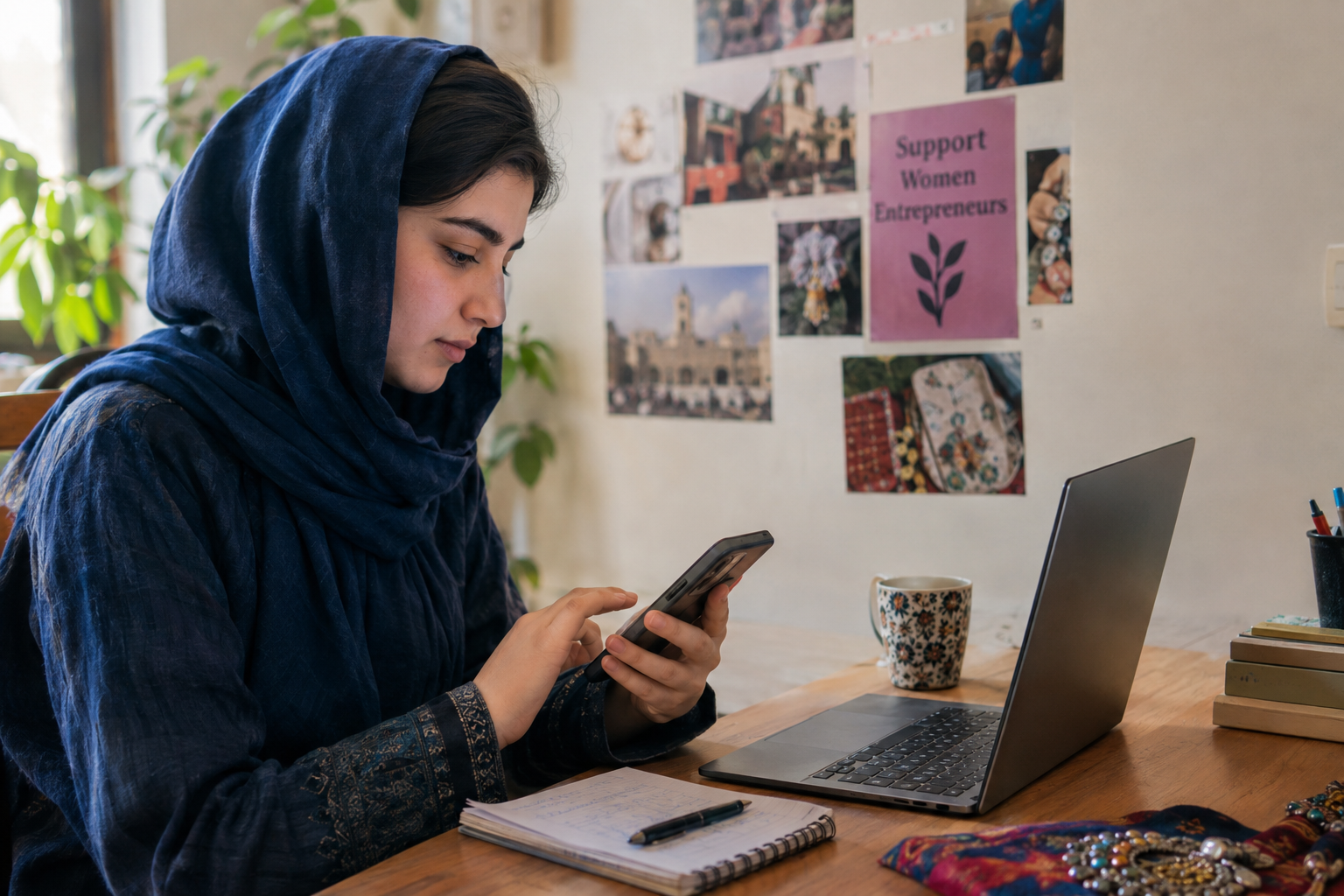
For some Afghan women, digital technology is becoming more than a means of communication. It is increasingly a way to maintain a business, reach customers, and generate income when conventional avenues for economic activity are difficult to access.
Across Afghanistan, women are using social media, messaging applications, and other digital tools to promote clothing, handicrafts, jewelry, cosmetics, food products, and services. Many of these activities are small-scale and home-based. A woman with a smartphone can advertise a product, communicate with customers, receive an order, and maintain a business relationship without operating a conventional shop.
This does not mean that digital technology has transformed women’s economic opportunities across Afghanistan. Nor does having an internet connection automatically translate into income or business growth. The more important question is whether women have the resources, skills, finance, infrastructure, and market connections necessary to turn digital access into meaningful economic activity.
This distinction is particularly important in Afghanistan.
A Changing Way of Doing Business
Afghanistan’s economic environment has changed considerably since 2021. Employment opportunities for women have become more limited, while access to conventional markets and workplaces can present practical challenges. Against this backdrop, some women have adapted by developing businesses that can be managed partly or entirely from home.
Digital platforms can make this adaptation possible.
Social media provides a relatively accessible way to display products and communicate with customers. Messaging applications allow entrepreneurs to discuss prices, confirm orders, and maintain relationships with buyers. For businesses operating on a small scale, these tools can reduce some of the costs associated with establishing a physical commercial presence.
Women producing handicrafts, clothing, food, cosmetics, jewelry, and other goods can potentially reach customers beyond their immediate neighbourhoods. In some cases, digital communication can also connect producers with suppliers and business partners outside their local area.
Yet online visibility should not be confused with commercial success. A business may have an active social-media page and still generate limited income. It may have customers but lack sufficient capital to increase production. It may receive orders but face difficulties collecting payment or delivering products.
Digital technology can open a door. It does not guarantee what lies beyond it.
The Digital Divide Is About More Than Internet Access
This is where the concept of the digital divide becomes important.
Jan van Dijk’s work on digital inequality provides a useful way of understanding why access to technology produces different outcomes for different people. Digital participation involves several interconnected dimensions: motivation to use technology, access to devices and connectivity, the skills needed to use technology effectively, and the ability to translate digital use into meaningful outcomes.
For Afghan women entrepreneurs, all four dimensions can matter.
A woman may be motivated to establish an online business but not have a reliable smartphone or affordable internet connection. Another may have a device and connectivity but lack the skills needed for digital marketing, financial management, cybersecurity, or customer management.
Even a woman who possesses these skills may encounter another set of challenges: How will she finance her inventory? How will customers pay her? How will products be delivered? Can she access markets beyond her immediate community?
These questions demonstrate why digital inclusion should not be understood simply as connecting people to the internet.
The real issue is whether people can use technology productively and convert that use into economic opportunity.
What the Evidence Tells Us
Available research provides some indication of the importance of women’s entrepreneurship in Afghanistan.
In 2026, UNDP, citing data from the Afghanistan Chamber of Commerce and Industries, reported that the number of official business licenses held by women had exceeded 10,000, compared with approximately 600 to 1,000 before 2021.
This is a significant change in reported formal registration, but it should be interpreted carefully. Business licenses do not capture all women engaged in trade. Many home-based and informal activities may not be registered, while the number of licenses does not tell us whether businesses are profitable or sustainable.
UNDP has also reported substantial support for women-led micro and small businesses through its programs. These figures demonstrate the scale of entrepreneurship-support initiatives, but they should not be treated as direct evidence of the impact of digital commerce.
Other evidence highlights the economic importance of entrepreneurship for women who are engaged in business. A 2024 UNDP study involving more than 3,100 women entrepreneurs found that 80 percent of respondents identified business income as their primary source of income.
At the same time, the study identified significant financial and mobility constraints. Forty-one percent of surveyed women were in debt, only 5 percent had received loans from banks or microfinance institutions, and 73 percent reported restrictions on travelling to local markets without a male guardian.
These findings illustrate an important point: digital business activity exists within a wider economic environment.
A woman can market her products online and still struggle to obtain capital. She can communicate with customers digitally and still face difficulties delivering products. She can have the skills to operate an online business but lack reliable financial services.
Technology therefore cannot be considered in isolation from the economic systems surrounding it.
From Social Media to Sustainable Business
Much of women’s online commerce appears to rely on familiar and relatively accessible platforms such as Facebook, Instagram, and WhatsApp.
This makes sense. These platforms can provide low-cost tools for marketing and communication without requiring businesses to establish sophisticated websites or e-commerce systems.
But dependence on a small number of platforms can also create limitations.
Businesses may have limited access to customer data, depend heavily on changing platform rules, and face risks if accounts are lost or disrupted. Many small businesses may also lack the technical capacity to use more advanced tools such as online stores, customer-management systems, digital analytics, or email marketing.
This does not mean that every small business needs a website or sophisticated digital infrastructure. Rather, it suggests that women entrepreneurs should have the choice and capacity to use different digital tools according to their needs.
The objective should not be to make every business technologically sophisticated. It should be to ensure that technology serves the business rather than becoming another barrier.
Finance May Matter as Much as Technology
One of the most important lessons from the available evidence is that digital access cannot substitute for access to capital.
An entrepreneur may know how to advertise a product online but still need money to purchase materials, maintain inventory, improve packaging, invest in equipment, or respond to increased demand.
This is particularly important for women operating small businesses from home. Limited access to formal finance can constrain business growth even when there is demand for their products.
For this reason, digital entrepreneurship initiatives are unlikely to achieve their full potential if they focus exclusively on digital skills.
Training in e-commerce and digital marketing is useful, but it needs to be accompanied by appropriate financial and business support.
Building the Infrastructure Around Digital Trade
Online commerce depends on much more than the internet.
A successful transaction requires a seller, a buyer, a product, a means of communication, a payment mechanism, and a way to deliver the product.
Weakness in any one of these areas can affect the entire transaction.
Reliable payment systems are particularly important. So are transportation and delivery services. Trust between sellers and customers also matters, especially when transactions take place without face-to-face interaction.
This means that strengthening women’s digital economic participation requires attention to the wider commercial environment.
Improving connectivity is important, but so are financial inclusion, payment systems, business services, logistics, market information, and customer trust.
Beyond the Most Common Products
Women’s businesses are often concentrated in areas such as clothing, jewelry, cosmetics, handicrafts, and food products.
These sectors can provide accessible entry points for small businesses, particularly where production can take place at home. But concentration in similar products may also create challenges if many businesses compete for the same customers.
There is not enough evidence to conclude that Afghanistan’s online women’s businesses have reached general market saturation. More research is needed on prices, demand, profitability, business survival, and competition.
Nevertheless, greater diversification could create additional opportunities.
Women entrepreneurs could explore specialized products, higher-value handicrafts, professional services, digital services, niche markets, and opportunities to connect with customers beyond their immediate communities.
The emphasis should be on identifying genuine market opportunities rather than encouraging all businesses to move into the same sectors.
Why This Matters Beyond Individual Businesses
Women’s economic participation has implications beyond individual entrepreneurs.
When women are able to generate income, they can contribute to household livelihoods, develop skills, build professional networks, and maintain economic connections with markets.
At the household level, entrepreneurship can become an important source of income. At the wider economic level, the participation of more people in productive activity can contribute to resilience and diversification.
Digital technology can support this process by lowering some of the barriers associated with marketing and communication.
But it should not be presented as a substitute for broader economic opportunities.
The objective should be to create conditions in which women can use digital tools as one component of productive economic participation.
What Can Be Done?
The evidence points toward a practical rather than purely technological approach.
First, digital skills should be connected to real business needs. Training can focus on e-commerce, digital marketing, financial literacy, cybersecurity, customer management, and practical business planning.
Second, affordable access to devices and connectivity remains important. Digital training is of limited value if participants cannot reliably access the technology required to apply their skills.
Third, financial inclusion should be part of digital entrepreneurship programs. Women need appropriate ways to save, invest, obtain working capital where available, and manage business finances.
Fourth, payment and delivery systems need attention. Online advertising becomes economically meaningful only when businesses can complete transactions efficiently.
Fifth, market access should receive greater emphasis. Women entrepreneurs can benefit from market information, product development, packaging, branding, networking, and connections with appropriate domestic and international markets.
Finally, more evidence is needed. Existing statistics tell us something about women’s entrepreneurship, but relatively little is known about the precise scale, profitability, and sustainability of women’s online businesses.
Future research should examine how many women-owned businesses actively use digital platforms, how much of their revenue comes from online sales, which platforms are most important, how businesses differ between urban and rural areas, and what factors determine whether an online business survives and grows.
A Digital Opportunity, Not a Digital Solution
The growth of women’s digital economic activity in Afghanistan should neither be overstated nor overlooked.
For some women, digital technology is providing a practical means of maintaining economic activity, reaching customers, and developing businesses under changing circumstances. For others, the benefits remain limited because access to technology is accompanied by constraints involving skills, finance, connectivity, payment systems, transportation, and markets.
The central lesson is therefore straightforward: digital access is a starting point, not an economic outcome.
Afghan women entrepreneurs need more than smartphones and internet connections. They need the skills to use technology effectively, the financial resources to operate businesses, the infrastructure to complete transactions, and access to markets where their products and services can generate sustainable returns.
Digital technology cannot resolve every constraint facing women entrepreneurs. But with the right combination of skills, resources, infrastructure, and market opportunities, it can become a useful instrument for strengthening women’s economic participation and resilience.
For Afghanistan, the challenge is not simply to bring more women online. It is to create the conditions in which being online can translate into productive, sustainable, and meaningful economic participation.
Madina Bahra is a Business Administration student at Ferdowsi University of Mashhad, Iran, with an interest in contemporary business and management issues.
This article is published at the author’s request as part of the Afghanistan Security Institute’s effort to provide students and young researchers with a platform to share their work. The views and opinions expressed are solely those of the author and do not reflect the views or positions of the Afghanistan Security Institute.